This is an excerpt from an article originally published in The Leprosy Mission International’s Leprosy Insights Magazine #19, written by Timothy Burton, Global Communications Lead at The Leprosy Mission International. You can read the full article here.
People in the tech industry say that the sector likes to ‘move fast and break things,’ and you could argue that no technology has moved faster or broken more things over the last few years than AI. Almost no sector has been left untouched by this rapid rise. Leprosy and NTDs are no different.
The power of artificial intelligence means that it could turbocharge our drive towards the interruption of leprosy transmission, making our work more accurate, more efficient, and more effective. But it also has the potential to put up barriers and create setbacks. In this article, we consider whether the advantages of AI within our sector outweigh the disadvantages.
Three ways AI can help us in our fight to defeat leprosy
- Recognising leprosy skin lesions and other symptoms to aid diagnosis
- Supporting data processing as we register new cases
- Categorising data to help us understand transmission, those at risk, and how we can improve diagnostics
How could AI be doing harm to our cause?
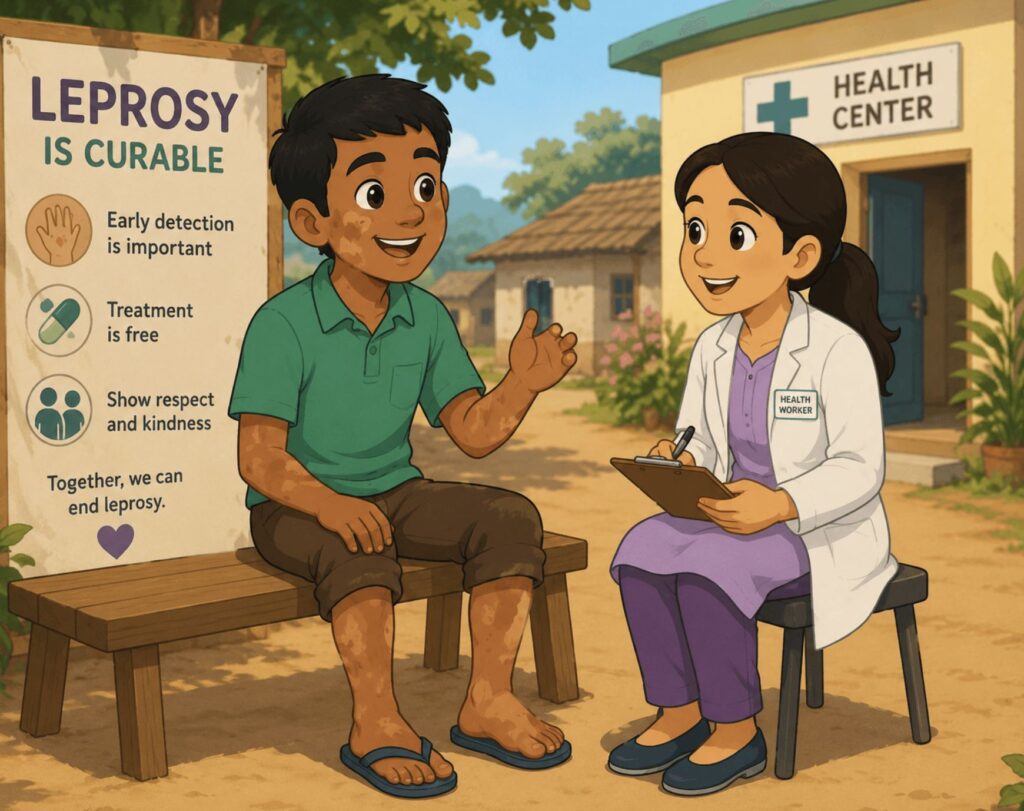
This was a topic covered in TLM International’s Duck Drop blog series, which is a series of opinion pieces from our Global Advocacy Lead, Mathias Duck. One of Mathias’ biggest concerns was around how leprosy and other disabilities are presented through generative AI, which creates text, images, and videos for us based on our prompts.
“AI leans towards what is most common and what might be considered typical. That is usually not persons with disabilities and if you ask specifically for persons with disabilities to be represented, you don’t get much diversity represented within that.”
AI reflects our world back to us, which perpetuates our stereotypes
AI could go on to dominate our culture and the materials that we see online, thereby shaping the way we see the world. As Mathias said, “If generative AI creates one-dimensional images that lack diversity, communities that are already marginalised and underrepresented become even more so. Persons affected by leprosy certainly fall within that category.”
Climate, discrimination, and the impact on women and girls
Climate concerns
As AI has grown so dramatically, so too has our understanding of its environmental impact. As the UN has highlighted, “AI-related water consumption could equal the basic annual domestic needs of 1.3bn people by the end of the decade, while its land footprint may exceed 14,500 square kilometres – roughly twice the size of the Jarkarta metropolitan area.”
If AI growth continues as it currently is, persons affected by leprosy will be exposed to greater risk of droughts, floods and extreme heat.
Discrimination
The UN’s Special Rapporteur on Disability has highlighted the impact AI can have on persons with disabilities.
The report shows how biases in AI can affect whether a person with disabilities can access social protection, healthcare, jobs or education. One of the Special Rapporteur’s greatest concerns was that many AI tools are built without the consultation of persons with disabilities and as a consequence they are inaccessible and not inclusive.
Women and girls
For vulnerable women in low-income countries, and for women with disabilities, AI bias strongly reinforces the belief that women, particularly minoritised women, do not belong in high-earning fields, in which they are already severely underrepresented. This issue has been extensively explored by organisations like UN Women.
For the same reason, AI can also come at a disadvantage to women’s health. As AI tools are mostly developed by men, when women use AI-powered systems to diagnose illnesses, they often receive inaccurate answers, as AI lacks an understanding of women’s bodies, and of how symptoms may present differently in women.
Final thoughts
If generative AI is to be used and if AI is to be used in non-technical contexts, we need to use it with a critical eye. Are the materials we are receiving from AI reflecting the world as we want it to be, or is it reflecting the worst of ourselves back to us? Are there biases implicit in what we’re receiving? Is the information accurate and verified? Are we allowing the ease of AI tools to prevent the voices of real persons affected by leprosy from being heard?
So do the pros outweigh the cons? The world is rarely so black and white. In some instances, AI tools are overwhelmingly positive. In other ways, AI is overwhelmingly negative. For the most part, it sits somewhere in the middle. What remains true: our human judgement and compassion are essential if we want to prevent AI from doing harm to persons affected by leprosy. If we want the pros to outweigh the cons, we have to take responsibility for how AI is used.